Garden State Sea Kayaking Symposium

I had a great time teaching at the Garden State Sea Kayaking Symposium last weekend.  Despite Tropical Storm Andrea barreling through Friday night, the weekend was mostly dry on land, but we definitely got wet on the water.

Saturday am was a scaled down version of my “Life on the Edge” course — a “graduate level” session on edging and bracing.  The highlight for me was the unplanned synchronized capsizing of three students, who happened to be in a row.  They all tried the same exercise, and all three went over, like a row of dominoes. Then they all rolled back up with smiles.  Winner!

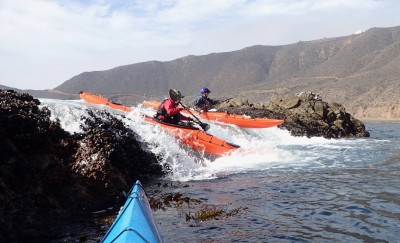
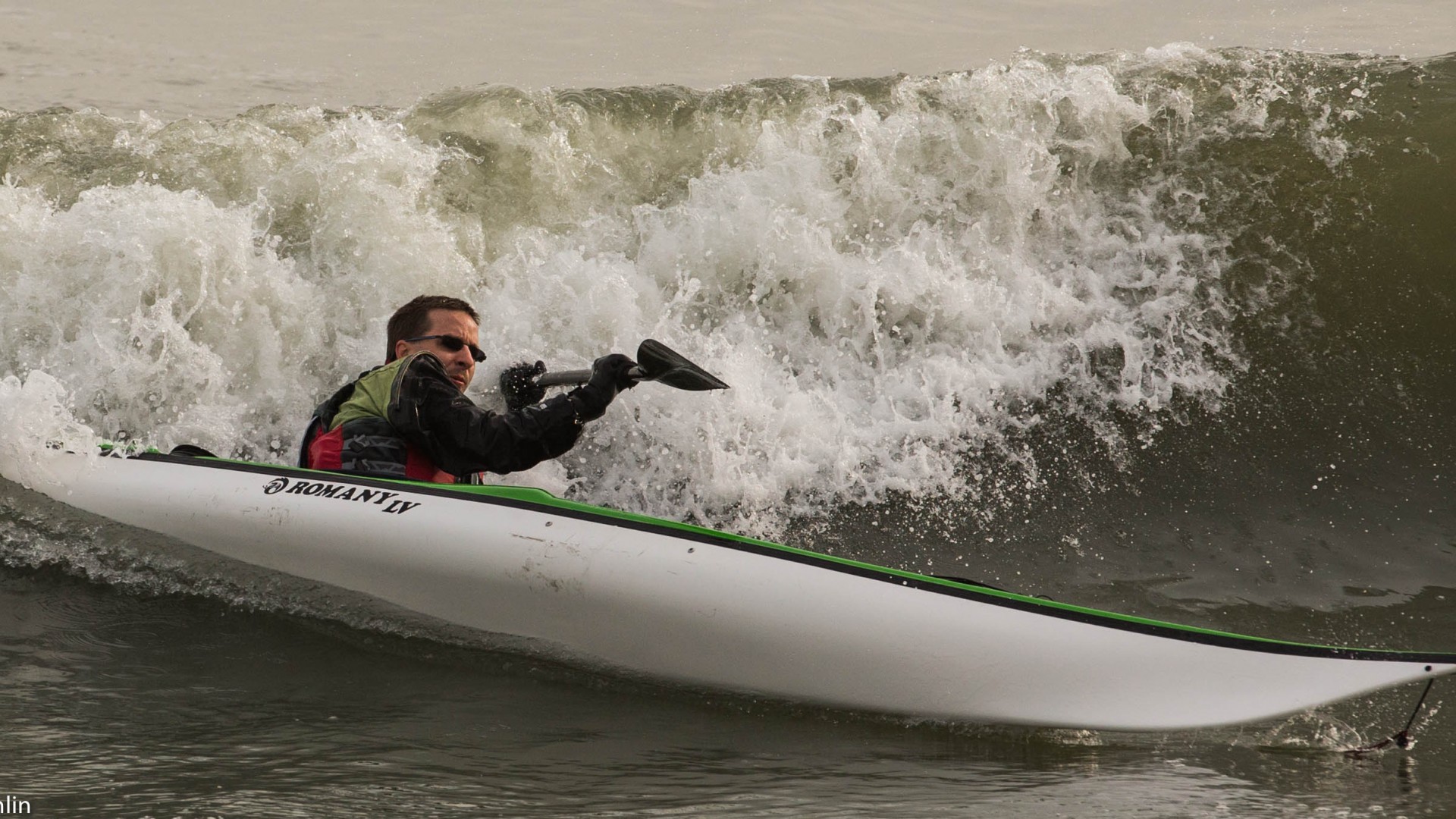
Saturday afternoon was Surfing I/II, and with the large surf from Andrea later became an advanced surf zone rescue course.  Here’s a key takeaway if you’re starting out in the surf zone.  Often you have to punch through a breaking wave or a wave that’s just about to break.  The ideal is to paddle hard toward the wave, tuck your body low to the deck, almost like the setup for a roll, and push through the wave.  As you push through, your front paddle blade immediately goes to the forward stroke and you keep digging to get through the impact zone.

What most newer kayak surfers do, however, is a very natural reaction.  They push through the wave, then sit up straight, take a second or two to catch their breath, and shake the water from their face.  They’ve lost all momentum, and are now sitting right in the impact zone for the next wave.  Try not to stop after that first (or second or third) wave — just keep digging hard!  Relax, clear your eyes and celebrate on the outside of the impact zone :-) .  Keep paddling until you’re sure you’re past the breakers.  Trust me on this one!

Sunday was a great intro to surfing session in the morning, followed by surfing I in the afternoon.  Great conditions and students who were eager to learn and ready to push themselves.  I look forward to next year!

Share

Surf Session Coach/Instructor Feedback — an Example

Someone recently asked me about the feedback I provide to students as part of a private instruction session, so I thought I’d share some observations made after a surf session.  The names have been removed to protect the innocent:

Overall:
I saw a significant improvement in your respective comfort levels, both in how you “addressed” the water, and in your body/boat alignment.  Some of that can likely be attributed to just getting comfortable in a new environment, but I saw more natural reactions to the waves and wind toward the end of the day.

A great example of this for me, and hopefully you’ll recall as well, is the ease in pivoting the boat after coming in on a wave, so you’re quickly facing back out.  At the start of the day, that was typically a series of sweep strokes, not too far on edge, and without a smooth transition from side to side.  By the end of the session you were both generally exiting the whitewater already starting to turn out to sea again, and using more aggressive low brace turns and reverse sweeps to get the bow around.  I saw you both (A in particular), also take off back out without worrying about getting exactly 90-degrees to the wave, knowing you could still punch through and brace (kind of a “forward stroke brace” where you just plant the paddle and let the stern swing around) on the ocean side and let the waves do some of the work for you.
Continue reading

Share

Plasma LED Aux Driving Lights

One of my goals when riding is to be as visible as possible.  On previous bikes I’ve mounted PIAA driving lights and Hyperlites — LED brake light additions that flash when the brakes are applied for extra attention.

On the V-strom, I wanted to go a slightly different route, in part because driving lights can use up lots of watts, which are in relatively limited supply on the strom.  And since I run with heated gear in the winter, I went with a low-watt option, LED driving lights. Continue reading

Share

Intentional Capsize to Avoid a Collision

The below series of photos (taken by Drew Trousdell, thanks!) is a good indication of how to avoid a collision when you’re sea kayak surfing.  Drew was confident enough to keep taking photos, rather than taking evasive action, in part because we spend so much time surfing together and have a good feel for what the other will do.

In the first photo, I’m getting sideways to the wave and realize Drew is down-wave, so I start to capsize into the wave in a high-brace.  As I go over, I’ll continue dropping my right elbow to protect my shoulder — you don’t want to leave that arm up high!

You may also notice the boat changes orientation from sideways-to-the-wave to more of a perpendicular alignment.  When you’re side-surfing (right side up or otherwise), shifting your brace toward the stern helps lock the stern into the wave more, and frees the bow to rotate with the path of the wave — I’m doing the same with my “drag” approach.

Note – you can click on the images to see the larger version.

Capsizing into the wave so I don't surf into the cameraman.

In the next series of photos, you’ll see the wave starts to take me along, and I want to avoid side surfing into Drew, so I move from a high-brace position to a diving blade angle to create more drag and hopefully let me fall off the back of the wave/foam.  It’s almost like an underwater draw — I’m hoping to create as much drag as possible.


Here's where I'm really starting to drag the paddle with a diving blade angle.

Converting the diving blade to more of a high brace recovery by dropping my left elbow and letting the paddle get back toward the surface.


Starting to roll up.


Share

Electrical Updates on the VFR

This weekend I spent some time adding electrical goodies to my ’95 Honda VFR 750 Interceptor.  There are some known electrical gremlins on this bike, so I wanted to add a voltage monitor and a powerlet outlet for my heated gear for the winter.  I can also use the outlet to power other goodies, like a GPS or even charge my phone in the tank bag.

To keep it all clean I purchased a six-circuit Blue Sea Systems Fuse Block (link to this and other products below from Amazon) from West Marine  and a generic 12v automotive relay from the local NAPA store.  I like the Blue Sea block because it’s a quality unit, has a central negative bus and keeps the wiring neat, plus each circuit is individually fused.  This really cleans up the wires going to the battery, and allowed me to use a relay between the battery and fuse block to so that anything powered through the block only comes on when the key is turned (switched power).

It had been a few years since I’d wired up a relay, so I used the helpful instructions on the Canyon Chasers web site, here.  That saved me a lot of time.  I put the fuse block at the tail end under the seat, which means longer runs of wiring, but a clean install and easy to access if needed.  I tapped the license plate wire as the switched power source to trigger the relay and did frequent tests with a voltmeter at each step of the process.

I have the relay down closer to the battery, where the tool pouch normally goes.  I may re-locate this at some point outside the frame near the r/r — not sure yet.

Next up was adding a Signal Dynamics heads-up voltmeter.  This is a tri-color LED that emits a color selection based on the amount of voltage at the battery.  The short version is that if your battery isn’t getting a charge, you get a warning.  Green means all is good. I wanted to mount the LED where I could see it without looking around too much, but also have it somewhat unobtrusive.  I considered the side fairings, and also directly in the dash, and was thinking about the right side of the dash.  Then I started taking the front fairing off and a few steps into the process realized the left inside of the wind screen area, near the mirror stalk support, would be out of the way, yet visible.  And a LOT easier to get to.  So that’s where it ended up — beside the front screw on the left side cover.  You can se

The LED mounts through a 1/4 inch hole and although it’s really bright in this photo, it’s actually not annoyingly so.  It’s on the left.  The other bright blue light is the neutral light, which is also reflecting in the wind screen.

The control unit is under the fairing on the left side, and the wires run back from there to the fuse block.  The last project for the weekend was adding a powerlet outlet.  These 12v outlets are great for heated gear (Widder vest, sleeves and vest), GPS units and other powered goodies. They have a strong junction that’s perfect for mobile environments.  It has a water-resistant spring loaded cover, and I actually had this one from a former bike.  I have another that hangs out from under the seat if needed for a passenger’s gear, or powering something else.

There is a nice trick install right in the steering head stem, but I wanted to avoid my vest connection wire running across the tank and flapping around.  Ideally for me is near my left knee, as that’s the side where the vest connection is, and I’ve had outlets in that area on every other bike.  It’s helpful for mounting/dismounting while you’re still plugged in, too.  I considered farther up, but was concerned about the cord interfering with turning the bars. After some experimenting with placement, I picked a spot in the middle left fairing, checked for clearance underneath and drilled out the hole.

Actually I started with the smallest drill bit I have, and built my way up (tape covered the area I was drilling, going very slowly, until I had a large enough opening to get my dremel “drum sander” attachment in the hole and could slowly enlarge it.  This was the longest part of the install, because I didn’t want to crack or stress the fairing.  After getting it installed, building and running some wiring looms for both and checking the switched power, I got it all buttoned up and looking good.  Of course I hope I don’t need the heated vest anytime soon!

Share

Upcoming Instruction at SK102

I’m looking forward to teaching a variety of topics April 28 & 29 at the Chesapeake Paddlers Association SK102 skills weekend.  Topics include rolling, “life on the edge” and other fun.  Hope to have my slackline set up, too!

Private instruction and small group sessions are also available for scheduling, particularly intro to surf zone and intermediate and advanced sea kayak surfing.  Contact me today for details.

Share

Combat Rolling Practice

I had the unexpected pleasure of cold-weather combat rolling in the surf the other day (yes, in February), and it was a good reminder of the need to practice rolling in the surf.  I took off on a wave and was headed left, when the wave steepened and dumped, before I could get my brace in place.  This happens on sandbar breaks, where the sea floor changes heights quickly.

I didn’t have time to get into any semblance of a setup position and was “windowshaded” over to the right side, and bounced around for several seconds.  My paddling buddy said he couldn’t see the boat in all the whitewater.  When things calmed down, I rolled up, but it took a little time to get my body position sorted out.

The reminder lesson was that it can take some time before you stop bouncing around, and sometimes you just have to ride it out.  But, it’s likely not as much time as it feels like, and you have plenty of air.  Just relax, keep your head tucked close to the boat (or the back deck in this case since the water was pinning me back), and roll up when you’re not bouncing around so much.

I plan to do more practice as the water warms up, just as a good reminder.  Here are a few combat roll practice sessions you can do in the surf.  Remember, don’t do these when there are surfers or others in the water around you, as you’ll be out of control while upside down.

  • Get sideways to the wave right after the impact zone, and capsize as the water reaches you.  Work both sides (left side to the wave, right side to the wave). Remember to roll up with your blade on the ocean side.
  • Get sideways like above, but don’t capsize before the wave reaches you — capsize as the wave reaches you, capsizing toward the beach.  Remember to tuck your head and start in the setup position at first.  Later you can hold the paddle different ways.
  • Line up facing into the waves and capsize as the wave is about to break on your boat — ride out the rough part, roll up and keep paddling through the surf zone.  Do the same thing with the wave coming from behind you as you face the beach (not surfing).
  • Finally, on some smaller waves, capsize while you’re surfing forward — you’ll have more momentum going and it adds some degree of difficulty.

Reminder — wear a helmet, do this with a partner nearby, and you should already have a reliable flat-water roll before attempting these.  Warmer water and smaller surf is best.  This is based on East Coast beach breaks, too.

Share